
How to Organize Kitchen Drawers for Faster Cooking
Published Updated

I bring a warm, detail-oriented eye to home routines, decluttering ideas, and everyday ways to make a space feel easier to live in.
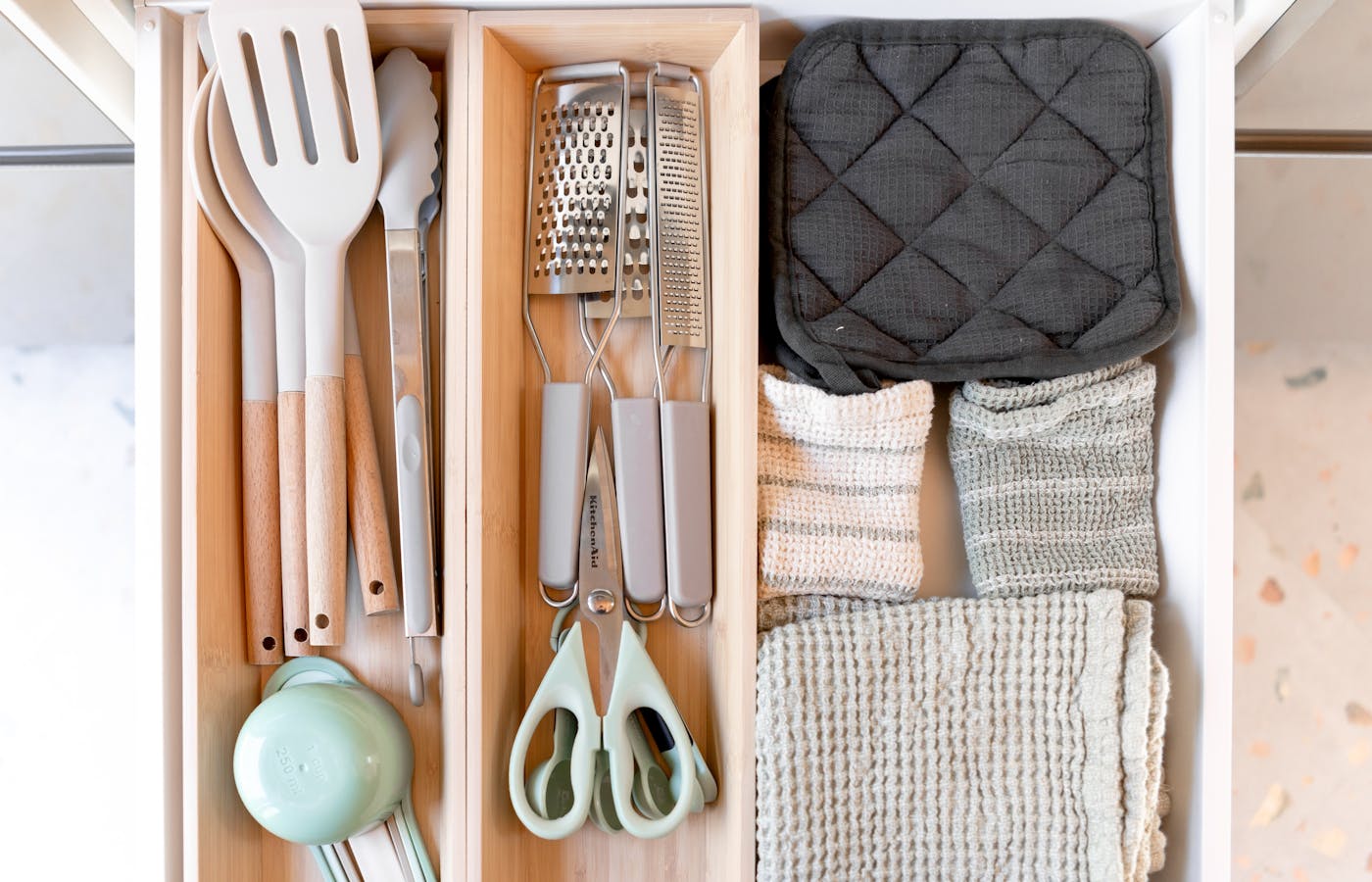
A messy kitchen drawer slows cooking in small ways that add up fast. You reach for a spatula and find a pastry brush. You need measuring spoons and pull out takeout packets. You open three drawers before finding the tool that should have been beside the stove.
Learning how to organize kitchen drawers for faster cooking is really about putting tools where your hands naturally need them. A drawer can look neat and still fail if the whisk is far from the mixing bowl, the can opener is buried under towels, or the everyday spatula shares space with tools used once a year.
Plan the drawers around the meal already in motion. When the stove is hot and ingredients are on the counter, the drawer should answer quickly. That means fewer duplicates, clearer zones, and a reset habit simple enough to keep.
Start with the drawer you open most while cooking
The best first drawer is the one you touch during an ordinary meal. For many kitchens, that is the utensil drawer near the stove or prep counter. Starting there gives you an immediate payoff because the tools you use every day become easier to grab without changing the whole kitchen at once.
Empty the drawer and watch what is actually inside. There may be cooking utensils, measuring tools, food clips, bottle openers, rubber bands, takeout chopsticks, appliance parts, towels, and mystery pieces from gadgets you no longer use. Sorting is easier when everything is visible on the counter.
Keep the keep-or-remove decisions simple. Make one group for daily cooking tools, one for occasional tools, one for duplicates, and one for items that belong somewhere else. If you are unsure about a tool, ask whether you used it in the last month and whether you would know where to reach for it during cooking.
The goal is not to make the drawer empty. The goal is to make the drawer honest. A useful cooking drawer should hold tools that belong to the way you actually cook most weeks.
Match each kitchen drawer to a cooking task
Drawers work faster when each one has a clear job. A drawer near the stove can hold spatulas, tongs, wooden spoons, and heat-safe tools. A drawer near the prep counter can hold peelers, measuring spoons, kitchen shears, a can opener, and small prep tools. A drawer near dishes can hold towels, trivets, or serving utensils.
This task-based setup reduces the tiny pauses that make cooking feel scattered. If a drawer is close to where the task happens, you do not need to cross the kitchen with wet hands or leave food unattended while looking for a tool. Placement matters more than a beautiful layout.
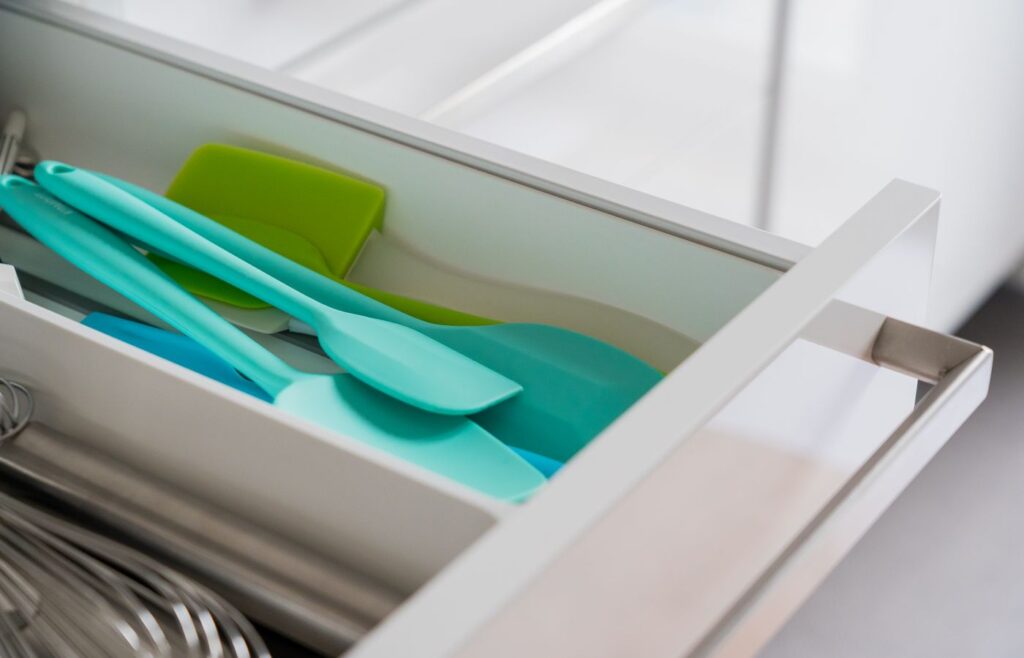
Think about motion. Where do you chop? Where do you stir? Where do you plate food? Where do leftovers get packed? The best drawer categories usually follow those motions: prep, stove, serving, storage, towels, and backup tools.
When a drawer has too many jobs, it becomes slow again. A drawer that holds spatulas, foil, batteries, scissors, lids, and towels may look familiar, but it asks you to search every time. Give each drawer a narrower purpose where the kitchen layout allows it.
Remove duplicates that crowd the tools you reach for first
Duplicates are one of the main reasons kitchen drawers stop working. It is common to own five spatulas but reach for the same two, or to keep several peelers when only one feels comfortable. Extra tools make the drawer look full, catch on each other, and hide the pieces you actually use.
Start by choosing the best version of each repeated tool. Keep the tongs that open smoothly, the spatula that fits your pan, the peeler that feels safe, and the measuring spoons that are easy to read. Move backup tools out of the main cooking drawer unless they serve a real purpose during the week.
Some duplicates are worth keeping, but they need a reason. Two spatulas may help if you cook eggs and vegetables at the same time. Extra measuring spoons may help during baking. Loose knives need protective storage that prevents reaching onto an exposed edge; random gadgets can move out of the everyday drawer.
Use a small holding spot for uncertain duplicates. If you do not reach for them after a few weeks of regular cooking, donate, recycle, or relocate them. The daily drawer should earn its space through use, not through guilt.
Use dividers that fit the tools instead of forcing the tools to fit
Drawer dividers help only when they match the drawer depth and the tools inside. A divider with narrow slots may work for forks and spoons but fail for bulky spatulas, tongs, graters, and measuring cups. If the divider creates awkward stacking, it becomes another obstacle.
Measure the drawer before buying anything. Check width, depth, height, and the space needed for handles to clear when the drawer closes. A shallow drawer may need low trays. A deep drawer may work better with adjustable bamboo dividers or small bins that keep categories separate.
Good divider choices usually do three things:
- Keep long handles from sliding sideways.
- Keep knife blades and sharp tools in suitable protective storage, separate from loose utensils.
- Make the most-used tools visible at a glance.
- Leave enough room to lift tools out without wrestling them free.
- Fit the drawer without blocking the drawer from closing smoothly.
Do not fill every inch. A drawer needs a little breathing room so tools can be lifted, returned, and cleaned around. If every slot is tight on day one, it will feel crowded again after a normal week. The fastest drawer is usually the one with fewer tools and clearer reach. If utensils are left on the counter because the drawer jams, reduce that drawer before adding counter storage. planning clear kitchen counters helps reserve the remaining surface for preparation.
Keep towels, trivets, and soft items from swallowing small tools
Kitchen towels, pot holders, and trivets often share drawers with cooking tools because they are used near the same area. That can work, but soft items spread out and cover smaller pieces. Measuring spoons, clips, peelers, and thermometers can disappear underneath a stack of cloth before you notice.
If towels belong in the drawer, give them their own side or a deep compartment. Fold them to a consistent size so they do not creep across the drawer. Pot holders and trivets are easier to grab when they sit flat or stand in a clear section instead of being shoved around utensils.
Small tools need boundaries. A narrow tray, small cup, or divided section can hold measuring spoons, clips, thermometers, or tiny specialty items. Without that boundary, the smallest pieces drift to the back and turn into clutter.
Check the drawer after one week of normal cooking. If towels are covering tools again, the drawer is trying to do too much. Move either the towels or the small tools to a better zone. This is also a good time to notice whether the drawer still closes easily when everyone is putting dishes away quickly.
Check the drawer after dishes return
A kitchen drawer does not stay organized by itself. The trick is making the reset short enough that it can happen during a regular kitchen cleanup. You should not need to empty every drawer each time. A weekly or twice-monthly touch-up is usually enough for the drawers used most often.
- Pull out anything that clearly belongs in another room or cabinet.
- Remove crumbs, loose wrappers, and broken bits from the drawer.
- Return tools to their assigned sections by task.
- Move unused duplicates away from the daily cooking zone.
- Wipe the divider or tray if food dust has collected.
- Close the drawer and open it again to check whether tools slide or catch.
This reset is also a quiet way to test whether the system is working. If the same item keeps landing in the wrong drawer, it may need a new home. If a divider shifts every time the drawer opens, use a compatible non-slip liner or an organizer secured as its maker directs. Do not add weight beyond the drawer's load rating.
A reset should make cooking easier next time, not create a showroom drawer. Keep the standard practical: tools visible, handles reachable, drawer closing cleanly, and daily items in the right cooking zone.
Make kitchen drawer organization easy for everyone to follow
A drawer system works better when the whole household can understand it. If only one person knows where the can opener, tongs, or measuring cups belong, the drawer will slowly drift back into a mixed pile. Simple categories beat clever categories in a shared kitchen.
Use plain zones such as stove tools, prep tools, towels, serving, and food storage. Labels can help inside deep drawers or homes where several people unload dishes. They do not need to be decorative; a small label on the tray or inside edge can be enough.
Watch for signs that the organization is too complicated:
- People leave tools on the counter instead of putting them away.
- The same drawer gets jammed or stuck.
- Small tools keep disappearing under larger ones.
- Cooking tools are stored far from where they are used.
- New items have no obvious place to go.

Keep this guide handy
An illustrated summary made for JundHaus. Read the guide above for the details and cautions.
Save to Pinterest (opens in a new tab)