
Create a Guest Landing Zone Without Clearing a Whole Closet
Published
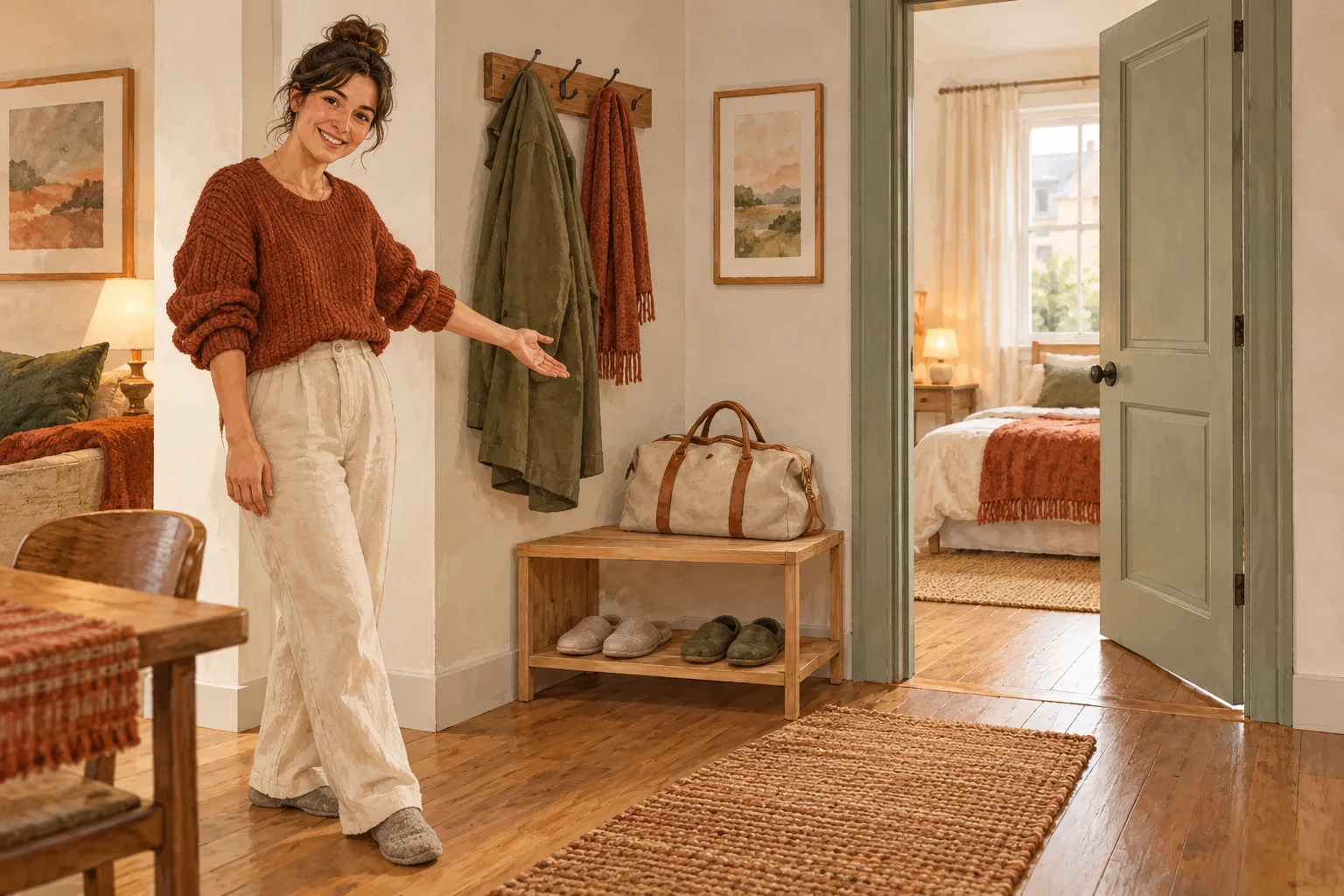
A guest staying for a few nights needs somewhere to put a bag and reach everyday belongings. That does not necessarily mean emptying your entire closet or covering the living-room floor with temporary organizers. Start by agreeing on one accessible place for the bag and a small amount of hanging space.
The arrangement should work while the home is in use: doors opening, someone getting to the bathroom and people putting their own belongings away. A corner that looks empty in a photograph may be part of a route the household needs all evening.
Ask what is arriving
Find out whether the guest has a small soft bag, a large suitcase or equipment that needs a particular location. Ask what they need to reach during the stay and whether bending, lifting or reaching would make your proposed spot difficult. Do not assume a guest can lift a case onto a high shelf.
For an ordinary weekend bag, an existing stable low shelf may be enough if it is suitable for the item and its load. A large case needs a different footprint. Avoid buying a stand before checking its size, instructions and how it affects access when the bag is open.
Discuss private storage too. Point out which drawer, hook or shelf is available rather than leaving a visitor to guess. You can offer a useful welcome without making personal paperwork, medicines or household members’ belongings available to rearrange.
Test the space with the bag open
Imagine a small apartment where the only spare corner is beside the bedroom door. A closed bag fits there, but opening it makes the door catch on the lid. The corner has not passed the test simply because the bag can be squeezed into it. Choose another suitable spot or a different way to access its contents.
Check the normal door swing, the path beside the bed and access to everyday fixtures. Consider what happens after dark, when shoes or an open bag can be harder to see. Do not leave belongings on stairs or in communal corridors, or block a building exit to gain indoor space.
The U.S. Fire Administration’s home escape planning guidance says doors and windows should not be blocked. Share the home’s relevant escape information with a guest and follow the building’s actual requirements. This storage suggestion does not establish a compliant clearance width or replace an accessibility assessment.
Offer limited space that stays usable
One suitable hook for a coat and one cleared drawer may be more helpful than scattering possessions among several rooms. Use existing fittings within their intended limits; do not hang a heavy bag from a door handle or improvise an overloaded hook above where someone sleeps.
If a drawer contains household items, move only what you own and have agreed to move. Put those items in a known temporary location, not on another person’s bed or in a box with no return plan. The existing small closet storage guide is useful if a closet is genuinely the right place, but a short visit does not require a whole closet project.
Leave room for the guest to return things after use. A drawer filled to its edge with spare hangers and gifts is not actually available. Tell the guest which towels or supplies are theirs rather than assuming that every visible basket is shared.
Keep charging out of the walking route
Show the guest an appropriate existing place to charge their devices using compatible equipment and the device’s instructions. The bag location and the charging location do not have to be the same. Do not run an extension across the room just to keep everything together.
Keep cords from becoming trip hazards, and do not conceal charging devices under bedding or in a closed bag. If the proposed spot depends on a makeshift electrical arrangement, choose another spot or ask the guest to use a suitable existing charging area. This is not a reason to alter sockets or add unassessed electrical fittings.
Explain the arrangement in a short handover
A useful welcome might be: “This shelf is for your bag, this drawer is empty, and these two hooks are available. Please keep the doorway clear. Your towel is here.” Adjust that conversation to what the person can use; it is an example, not a rule that every visit needs exactly those spaces.
Ask whether the arrangement works after the first unpacking. If belongings keep appearing on a chair because the assigned drawer is difficult to open, fix the access problem rather than adding more labels. In a shared home, make sure everyone understands which space is temporarily in use.
At departure, check the designated places together for forgotten items and restore what was moved. If a forgotten item needs returning, give it an owner and a next action rather than leaving it in the guest spot indefinitely. The next visit should begin with available space, not a collection of possessions left by earlier visitors.