
Use a Review Box for Sentimental Items Without a Forced Deadline
Published
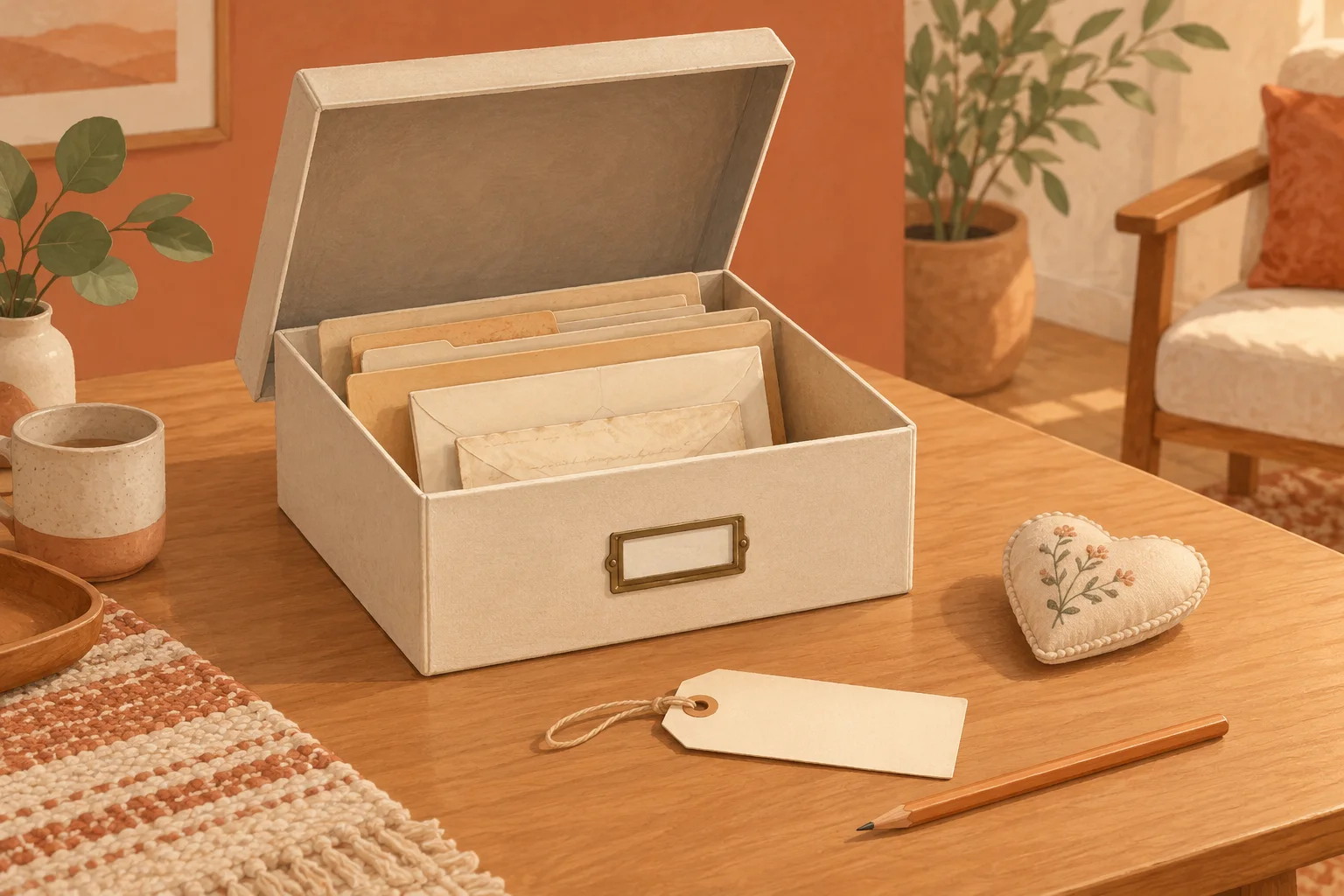
A review box can hold belongings you are not ready to decide about without pretending that they have already been selected for donation. Give it a clear purpose: these items are awaiting a particular decision, conversation or piece of information. The box is not an automatic deadline to discard them.
Start with your own belongings. Shared, borrowed or inherited items with unresolved ownership need the relevant people involved. Do not place someone else’s possessions in a box that another household member could mistake for outgoing donations.
Choose what belongs in review
Separate an uncertain sentimental item from something you have already chosen to keep. A letter you value does not need to pass another test simply because a box exists. An object with a practical legal, financial or ownership question may need a records or advice process instead of a sentimental sorting exercise.
Use the review space for a manageable group. You might be deciding whether to display a family object, asking someone about an unidentified photograph or choosing where a small collection can live. Keep that unresolved question with the item so you do not have to start from an unexplained pile next time.
| Uncertainty | Possible next step |
|---|---|
| Unknown person in a photograph | Ask the relative who may recognize them |
| Shared ownership | Discuss permission and custody before moving or discarding it |
| Worth keeping, no safe home yet | Find an appropriate storage or display location |
| Unsure whether to keep | Leave a short note about what makes the decision difficult and revisit voluntarily |
Use suitable storage, not any spare box
Check the object’s condition and material before containing it. Do not fold fragile paper to fit, place a heavy object on photographs or store damp fabric in a sealed container. Items that need specialist care should not be forced into the same mixed review box.
The Library of Congress care guidance for paper recommends clean handling, supportive enclosures and avoiding damaging fasteners, tape and unsuitable environmental conditions. It does not certify a particular household container for every photograph, textile or object.
Keep papers supported and separate from objects that could stain, scratch or crush them. If an item is fragile, deteriorating or valuable, obtain appropriate conservation advice before cleaning, repairing or repackaging it. A sorting session is not a reason to tape a torn original back together.
Leave a note that helps the next decision
Write the item’s identity, owner if known and the question still open on a separate note. Add who you plan to ask or what you need to find out. Avoid adhesive labels directly on a delicate original.
A hypothetical note might say: “Small blue notebook from the shared family papers; ask Alex who it belonged to before deciding where it goes.” That is more useful than a tag saying sentimental. Do not invent a family story to make an unknown object easier to classify.
A photograph of an object can help you remember it or discuss it with someone, but taking a picture does not mean you must give the original away. Digital copies also need their own storage and identification. Keep private correspondence and images in a place appropriate to the people whose information they contain.
Choose a review opportunity, not a disposal countdown
Pick a time when you want to return to the question, perhaps when the relevant person visits or when you can arrange suitable storage. If the moment arrives and you are not ready, acknowledge that rather than treating a calendar reminder as an instruction to discard.
Capacity still matters in a shared home. If the review area fills, discuss what can be resolved, stored differently or given a clearer place before adding another box. That conversation can be about safe space and ownership without demanding a decision about every memory.
The broader questions before keeping an item can help with ordinary sorting. Set them aside when they pressure you toward a decision you have not chosen. If the process becomes overwhelming, stop and seek support appropriate to your situation; this storage method is not mental-health treatment.
Keep the review box distinguishable
Label the outside as review, identify whose items it contains and store it somewhere safe and accessible without blocking a route. Keep it apart from recycling, rubbish and donation containers. When a decision is made, move the item deliberately to its agreed home and update the note. Unresolved does not have to mean forgotten, and a smaller clear set of questions is easier to revisit than a mixed box nobody understands.