
Read the Whole Garment Care Label Before Washing
Published
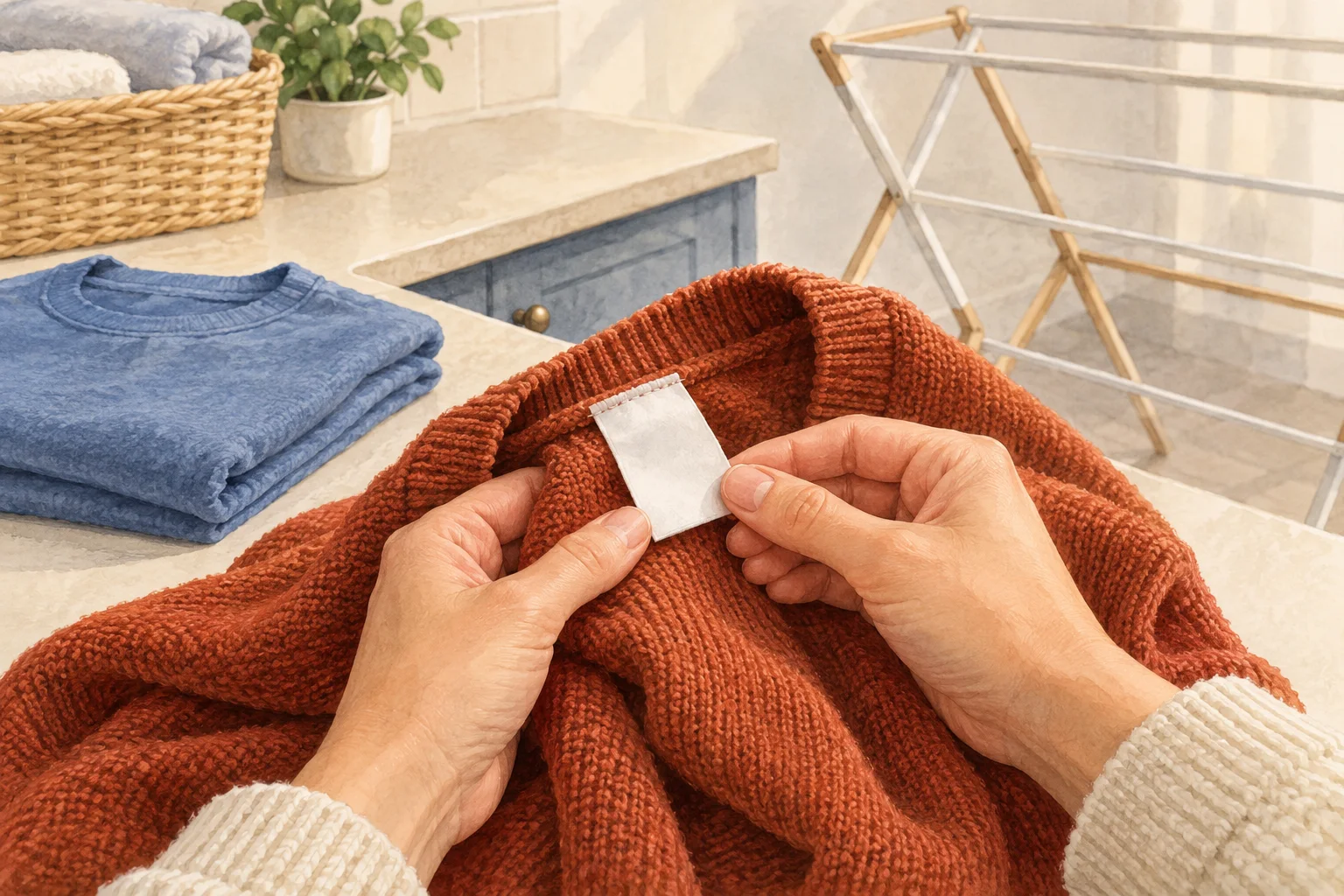
A garment can permit washing but still need a particular drying method. Reading only the temperature, or choosing a machine cycle from the fiber name, misses the rest of the care instruction. Check the whole label before the item joins the laundry.
This is especially useful for unfamiliar clothes, lined items, decorated garments and household members’ pieces that you do not normally wash. A wool label on one sweater does not establish how another sweater should be treated.
Find the instruction that belongs to the finished garment
Look inside seams and on both sides of attached labels. Fiber content, size and country of origin may appear near care information, but they answer different questions. A detachable belt, removable lining or separate piece may also have its own care directions.
Read supplementary words as well as symbols. Instructions about washing separately, removing a component or avoiding a process can be easy to miss in a crowded label. If the label is damaged or missing, ask the garment maker or a suitable textile-care professional. Do not copy instructions from a visually similar item.
In the United States, the FTC’s garment care labeling explanation distinguishes care directions from fiber information and discusses the garment’s components. That is a U.S. rule, not proof that every textile item worldwide must carry the same label.
Read treatment and temperature together
In the GINETEX system, the wash tub concerns washing, the number gives a maximum Celsius temperature and bars below it indicate a milder mechanical process. A hand-wash instruction is not simply a machine-wash temperature. Crossed-out treatment symbols prohibit the process concerned.
Use the official care symbol reference to identify the actual symbol and its version rather than guessing from a tiny photograph. This article does not reproduce a symbol chart. Systems can differ by market, and words or additional instructions may change the practical decision.
Once you understand the garment’s direction, find the corresponding settings in your machine’s manual. A program called “gentle” does not establish its temperature, spin and action on every appliance. Do not assume the hottest allowed temperature is required for every ordinary wash.
Plan the drying before starting the wash
A hypothetical shirt might permit an appropriate machine wash but require line drying. If your only available plan is a tumble dryer, the wash has not solved the whole job. Set up the permitted drying arrangement before you begin, or choose another time when you can complete it correctly.
Read tumble-drying and natural-drying instructions separately. GINETEX distinguishes those processes, including forms of flat or line drying and shade requirements. Do not interpret permission to wash as permission to tumble dry. Likewise, ironing has its own limits.
The small laundry-area storage guide covers making room for drying without blocking access. Use a suitable stable rack as instructed, keep walkways clear and do not hang wet clothes on electrical equipment or obstruct appliance ventilation.
Sort by instructions you can actually follow
Imagine three items on the counter: a washable shirt with a specific drying instruction, a hand-wash sweater and a dryclean-only jacket. Their similar color does not make them one ordinary machine load. Each needs its own supported process, or a decision to seek professional care.
Start with the treatment restrictions, then consider compatible colors, the product instructions and the machine’s load guidance. Do not overload a small cycle to avoid another load. A family member’s label preference also does not authorize you to experiment with a different process on their clothes.
If a label is ambiguous, keep the garment out of the uncertain load and resolve the question. Set it aside in an agreed place with the reason, rather than leaving it on the floor or silently putting it back among clean clothes.
Stain removal needs its own compatibility check
Ordinary care instructions are not permission for every stain treatment. Check the garment’s warnings and the intended product’s directions before applying anything. Do not add bleach because the stain is stubborn or combine cleaning products to make the treatment stronger.
A professional cleaner should receive the garment’s label and what you know about a stain or previous treatment. Be honest about unknown products. Do not promise a result from a home test or hide damage by washing again on a harsher setting.
After laundering, follow the stated drying and finishing directions before putting the item away. If the label irritates the wearer, preserve a readable reference and ask the maker about a suitable alternative rather than losing the instructions without a plan. Keep the directions attached to the garment’s identity so the next person doing laundry does not have to guess.