
Measure a Storage Space Before Buying Bins
Published
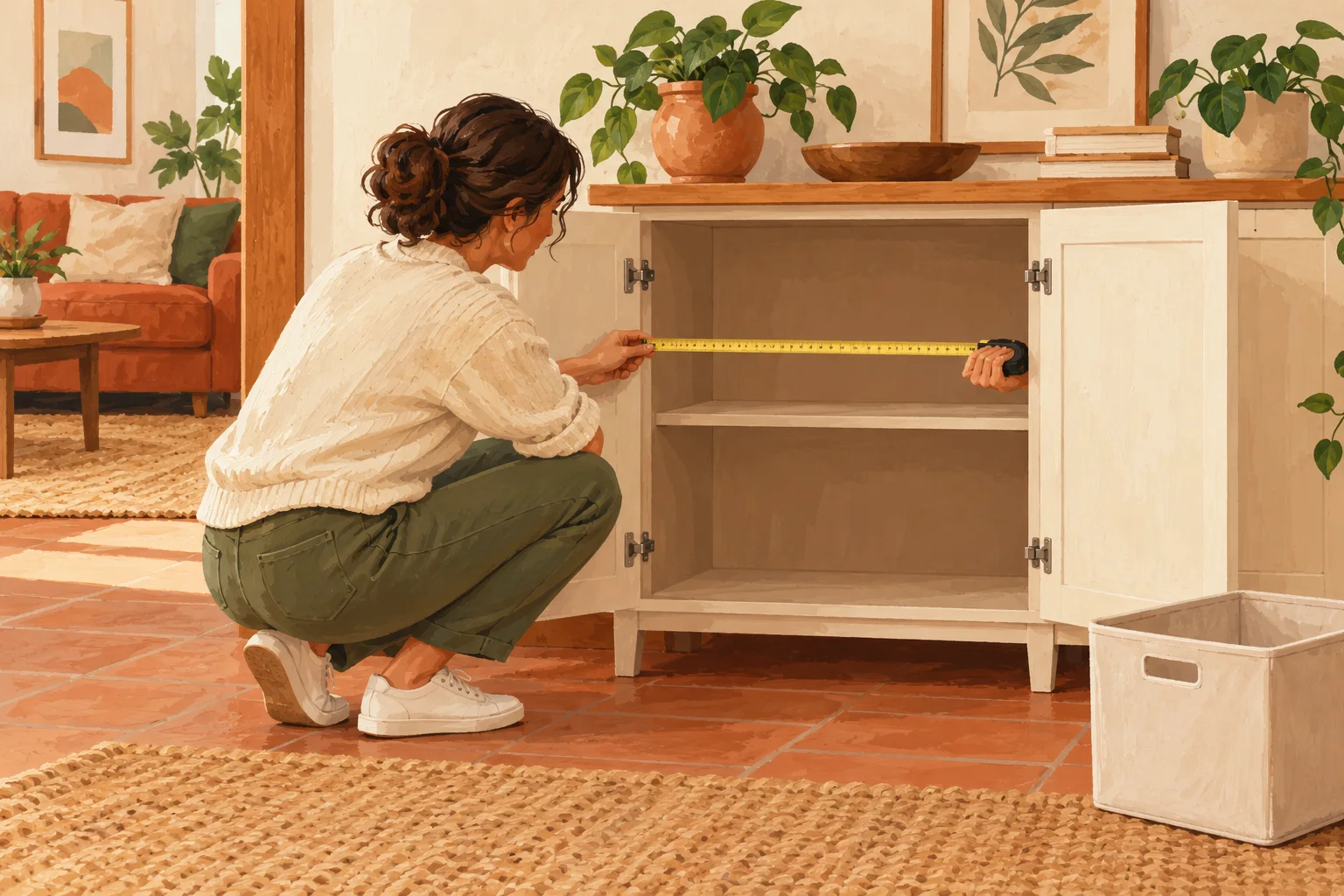
Measure the opening a storage bin must pass through, not just the empty space behind it. A cupboard may have plenty of interior width while its hinge, door or frame prevents a rigid box from entering. A bin that fits only when tilted can still be awkward once it is full.
Before shopping, empty only the section you can handle safely and note how it is used. Keep exits clear and put the contents somewhere stable. Do not climb on a chair, remove structural parts or overload another shelf to obtain a measurement.
Take three sets of measurements
First, measure the usable interior space: width, depth and height. Include fixed obstructions such as hinges, pipes, shelf supports and door hardware. A shelf’s advertised overall depth may include a frame or lip that does not support the bottom of a bin.
Second, measure the access opening with the door in its normal usable position. Check the narrowest point the bin must pass, including a neighboring door or wall that limits the swing. A fully open door in a product photograph may not match what your room permits.
Third, consider the route out. Can you bring the bin forward, lift it comfortably and set it down without moving another stack? Measure the retrieval space, not a theoretical position that requires a precise sequence of tilts. If you use a mobility aid or have limited reach, base the route on your actual access needs.
Compare external dimensions, including the lid
Product listings may emphasize capacity in liters or show internal dimensions. Those numbers do not establish the space occupied by handles, a lid or a flared top rim. Find the external dimensions of the exact model and confirm which way the measurements are listed.
Check whether the lid can be opened in place or whether the whole bin must come out first. A hinged lid needs opening space above it. A detachable lid needs somewhere to go while you use the contents. An unlidded tray may suit daily access better than a container that only just fits the shelf.
If the listing is incomplete, ask the seller or measure a sample where possible. Do not treat a photograph as a scale drawing. Keep the model reference with your note so you do not later buy a similar-looking size from the same range.
A hypothetical cupboard comparison
Imagine an interior shelf 48 cm wide, 32 cm deep and 27 cm high, but a clear door opening only 42 cm wide. The figures below are invented to show the access issue, not a recommendation for a particular product or a universal clearance.
| Bin | Width × depth × height | What still needs checking |
|---|---|---|
| A | 44 × 29 × 24 cm | Too wide for straight removal through the42 cm opening |
| B | 38 × 28 × 23 cm | Nominally smaller, but lid, handles and retrieval access still matter |
Bin A fits the interior width on paper, yet the opening is the limiting measurement. Bin B is a more plausible candidate, not a guaranteed fit. Its rim, taper, actual measurements and the space your hand needs must still be considered. Do not assume the few spare centimeters can all be used for another narrow object.
Check the contents before choosing capacity
Gather the items the bin will actually hold. Long tools, folded linens and small packets use space differently. Arrange them provisionally within a measured footprint on a stable surface, keeping anything hazardous in its required original storage rather than moving it into a trial box.
Think about filled weight. A large bin of light fabric and the same bin of books are different lifting jobs. Choose a size you can retrieve comfortably within the container and shelf instructions. This guide cannot supply a safe lifting limit for you or a load rating for unknown furniture.
For spaces used every day, accessible contents may matter more than maximum volume. Our guide to storage for small closets considers where frequently used items belong. A container that requires lifting another full box first may be better reserved for occasional items, if the arrangement is otherwise safe.
Test the access without committing the whole shelf
Use a ruler and a simple paper footprint to visualize the proposed dimensions. It will not reproduce rigidity, handles or weight, but it can reveal an obvious conflict with a hinge or door swing. Do not build a heavy mockup or climb to try it.
Buy one suitable sample if practical before replacing an entire set. Test it empty, then with an appropriate manageable load under the product instructions. Confirm you can grip, withdraw, open and return it normally. Stop if a shelf moves, fittings look damaged or retrieval requires an awkward overhead lift.
The CPSC’s furniture tip-over guidance emphasizes securing furniture appropriately. Adding matching bins is not a substitute for the manufacturer’s anchoring, installation and load instructions. Once the arrangement works, keep the actual bin model and usable measurements in your storage note rather than measuring the same cupboard again on the next shopping trip.