
How to Organize a Junk Drawer So It Stays Useful
Published Updated

By Silas Payao
I write practical cleaning and organization guides focused on simple routines, realistic storage ideas, and calmer home systems.

A junk drawer is not automatically a failure. Most homes need one place for the small things that do not deserve a whole shelf: tape, pens, batteries, scissors, spare keys, coupons, rubber bands, chargers, and the tiny part you are sure belongs to something.
The problem starts when the drawer stops being useful and becomes a place where every small decision disappears. Learning how to organize a junk drawer means keeping the helpful catchall, but giving it enough limits that you can still find a pen, a stamp, or a screwdriver when the house is already busy.
One practical safety check belongs in this project before the organizer comes out: batteries, blades, medicine, matches, and tiny choking-size pieces need different treatment than pens and tape. A useful drawer is still a drawer people open quickly, sometimes with one hand.
Empty the junk drawer before deciding what belongs there
Start by taking everything out of the drawer. This sounds like extra work, but it prevents the usual half-sort where the top layer gets neater and the buried clutter stays untouched. Put the contents on a clear counter or table so you can see the whole collection at once.
Remove ordinary trash first: dried pens, expired coupons, broken rubber bands, empty packaging, and crumbs. Set used batteries aside safely for disposal under local rules; do not mix them with metal objects or household trash by default. This first pass should be quick. Do not turn it into a memory project.
Wipe the drawer while it is empty. A clean base makes it easier to see how much space you actually have. If the drawer sticks, has a broken liner, or catches on loose objects, fix that before putting anything back. The drawer needs to open easily or the system will fail in daily use.
Sort small items by job instead of by random shape
Small objects become easier to manage when they are sorted by what they help you do. Pens, markers, tape, scissors, batteries, keys, small tools, stamps, gift cards, chargers, and household hardware may all be in one drawer, but they should not be one category. A drawer with one big category called miscellaneous is just clutter with a label.
Make practical groups on the counter before choosing dividers. You may find that some categories do not belong in this drawer at all. Medicine should usually live somewhere safer. Important documents need a paper system. Tools used often may need a small toolbox. The junk drawer should keep quick-use items, not absorb every unfinished decision.
Be especially careful with items that create risk when mixed together. Loose batteries, sharp blades, medication, matches, and small parts that children or pets could reach do not belong in an open catchall drawer. If the drawer is in a kitchen or entryway, assume someone will open it quickly and without paying much attention.
| Category | Keep in the drawer if |
|---|---|
| Writing tools | They work and are used often |
| Batteries | Their terminals are protected, packaging is intact, and access is secured |
| Small tools | They solve quick household tasks |
| Coupons or cards | They have current value and a limit |
Give the junk drawer fewer categories than you think
A useful drawer usually needs fewer sections, not more. Too many tiny compartments can become annoying because every item needs a perfect destination. Start with four to six categories that match your real life: writing, tape and labels, batteries, small tools, keys, and temporary paper.
Use containers you already have before buying anything. Small boxes, jar lids, shallow trays, cut-down cardboard, silicone muffin cups, or spare drawer organizers can all work. The point is to create boundaries, not to make the drawer look expensive. If a divider slides around, add a bit of removable grip liner underneath.
Before settling on the final layout, place the most-used category where your hand naturally goes first. If you open the drawer for scissors every week, scissors should not hide behind old gift cards. If batteries are rare but important, they can sit farther back in a small labeled box.
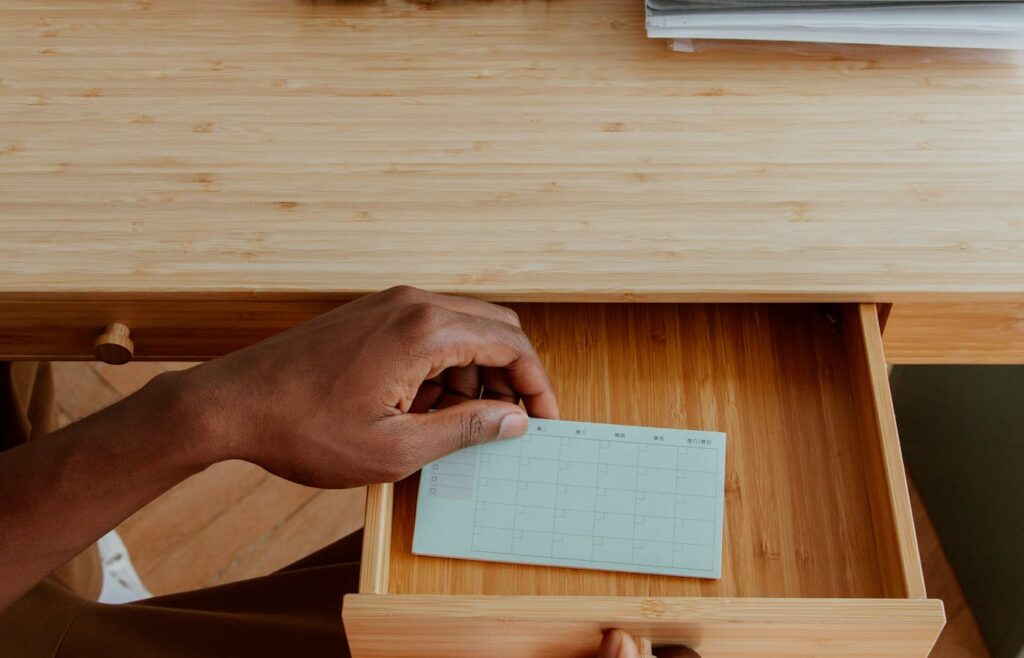
- Keep daily-use items near the front of the drawer.
- Use sheaths or protective covers for sharp tools, and secure them from children.
- Store batteries away from loose metal objects.
- Use one small section for temporary items only.
- Leave a little empty space so the drawer can close easily.
Set limits for the items that multiply quietly
Junk drawers usually overflow because a few categories multiply without being noticed. Pens, twist ties, sauce packets, takeout menus, batteries, old keys, charging cables, and coupons can grow from useful to ridiculous. A limit protects the drawer from becoming a storage unit for small maybes.
Choose a visible limit for each repeating category. Keep five working pens, one roll of tape, two small notepads, one set of spare keys, one small battery box, and only the cables you can identify. If you do not know what a cable charges, test it or move it to a short-term review box with a date.
Keep temporary papers from taking over the drawer
Flat papers can cover the tools beneath them. Receipts, coupons, school notes, appointment cards, small manuals, and return slips may look orderly from above while making the drawer harder to search.
Give paper one narrow section or one envelope. If the paper does not fit there, it needs another home or it needs to leave. Active papers should have a next action: call, return, file, pay, schedule, or recycle. A paper with no next action should not live in the junk drawer just because it is small.
- Keep current coupons in one envelope.
- Move receipts needed for returns to a labeled spot.
- Recycle manuals that are no longer useful.
- Do not store legal, tax, or medical papers in the drawer.
- Review temporary paper before it becomes a hidden pile.
Reset the junk drawer before it becomes a junk drawer again
The drawer will collect new items because that is its job. The goal is not to keep it frozen. The goal is to reset it before it becomes frustrating. A five-minute reset every few weeks is usually enough if the categories and limits are clear.
Open the drawer, remove trash, test pens, return items that belong elsewhere, check the temporary paper section, and put each category back inside its boundary. If one section overflows every time, the limit may be wrong or the item may need a better home outside the drawer.
The best reset also asks whether the drawer is in the right place. A kitchen junk drawer may be perfect for tape, scissors, and pens, but awkward for spare keys or school forms. An entry drawer may be better for keys, sunglasses, and stamps. Let the drawer serve the room it lives in instead of trying to serve the whole house.
- Pull out trash and dead items first.
- Return misplaced objects to their real rooms.
- Test pens; inspect battery packaging and separate used cells for proper disposal.
- Review temporary papers and coupons.
- Close the drawer only when every section has breathing room.
For small cells, the CPSC button battery guidance calls for immediate secure storage and protected terminals on used cells. A shallow divider does not prevent a child from reaching a battery. Use a separate secured location when the drawer is accessible.

Keep this guide handy
An illustrated summary made for JundHaus. Read the guide above for the details and cautions.
Save to Pinterest (opens in a new tab)